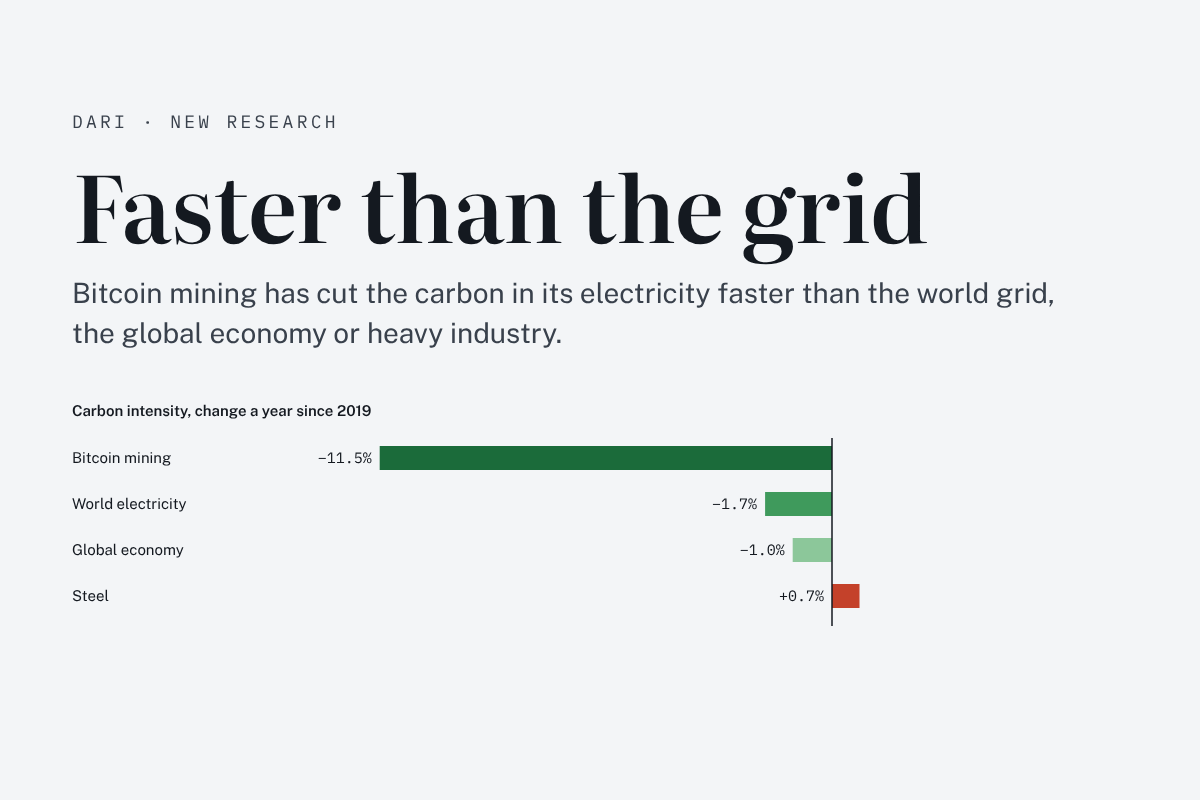
Faster than the grid: Bitcoin mining has cut the carbon in its electricity by 11.5% a year since 2019, against 1.7% for the world grid.

Faster than the grid

Author
Dr. Simon Collins
Reading Time
13
min
Subject
Energy claims
Date
November 27, 2026

We checked Bitcoin’s emissions against the world’s grids, its economy and its heaviest industries, and found that Bitcoin mining has cut the carbon in its electricity faster than any of them.

What we found
  • Since 2019, the carbon in each kilowatt-hour used for mining has fallen 11.5% a year, from 597 to about 248 grams. The world’s grid managed 1.7% a year.
  • Mining’s electricity is now about 47% cleaner than the world average grid. In 2019 it was 14% dirtier.
  • Coal fell from 36.6% of mining’s electricity in 2022 to 8.0% in 2025, with renewables taking more of its place than gas.
  • Bitcoin miners buy power that wind and solar farms cannot sell, in hours when prices fall to zero or below.
  • Total emissions rose with the network until late 2025 and are about a fifth lower a year later, mostly because newer machines use less energy for the same work.
Read the full interactive report

Share this post
Continue Reading
See All Articles
Bar chart: yearly change in carbon intensity - Bitcoin mining -11.5%, world electricity -1.7%, global economy -1.0%, steel +0.7%.
Energy claims
November 27, 2026

Faster than the grid

Bitcoin mining has cut the carbon in each kilowatt-hour it uses by 11.5% a year since 2019, several times faster than the world grid, the global economy or heavy industry.
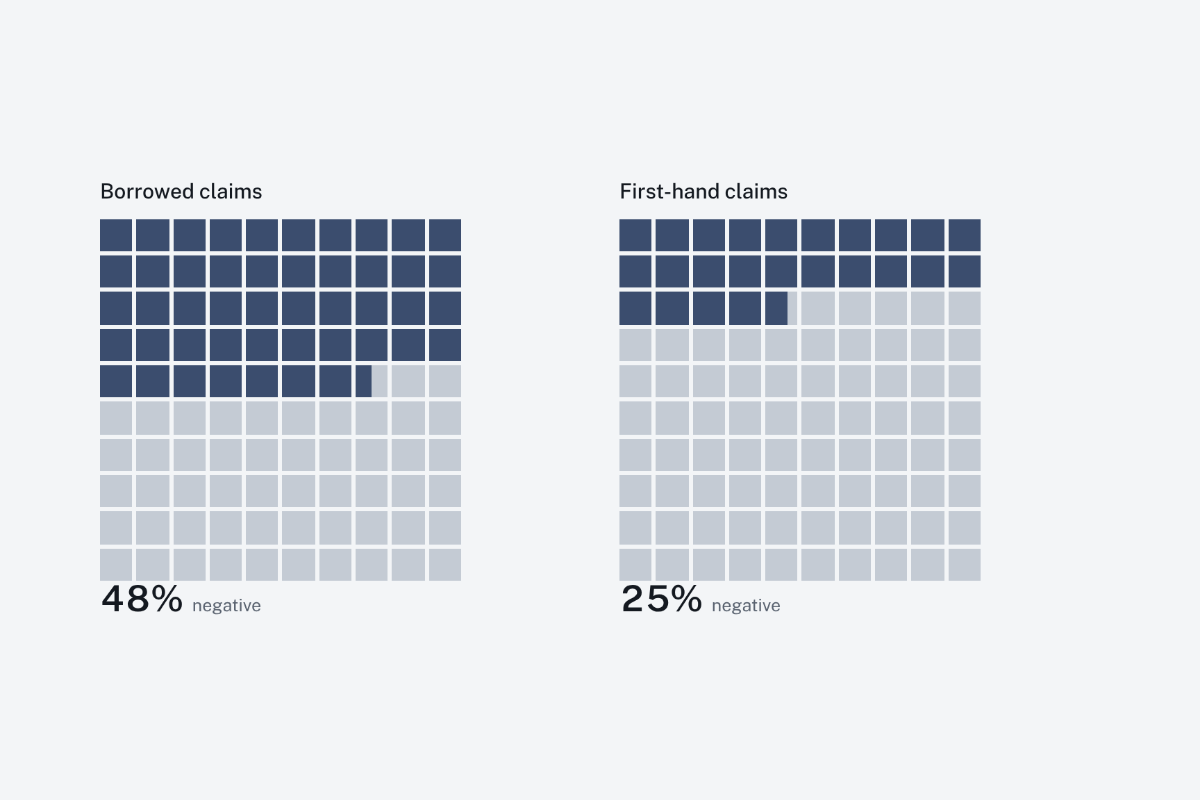
Waffle charts: 48% of borrowed claims about Bitcoin’s energy use are negative, against 25% of first-hand claims.
Energy claims
October 29, 2026

Second-hand gloom

We had AI read every mention of Bitcoin and energy in more than 7,000 academic papers. Most of the case they make against Bitcoin is second-hand, often uncited, and sometimes contains errors.
Refugees
July 14, 2025

Bring Only What You Can Carry

Over 329,000 refugees have used Bitcoin to protect or move wealth. That number could hit 7M+ by 2035. Read our new report on Bitcoin as a financial lifeline.